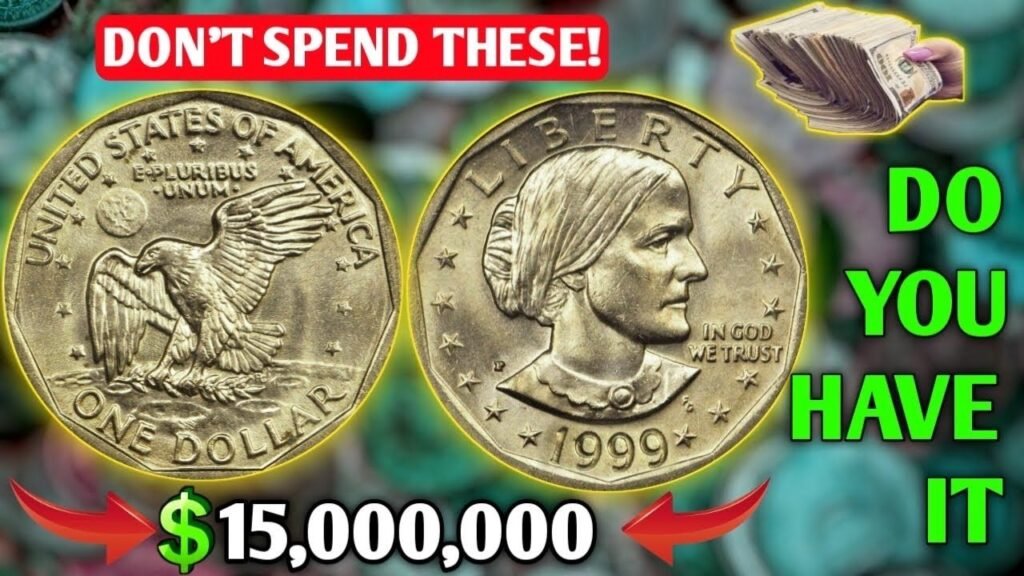
The 1999-P Susan B. Anthony one-dollar coin may look like an ordinary dollar, but some examples can be worth much more than face value. The key is not simply the year or the fact that it is an older modern coin. Condition, grading and unusual mint errors can make a major difference.
The 1999-P coin was struck at the Philadelphia Mint, and more than 29 million were produced. That means most examples are common. However, exceptionally well-preserved coins are much harder to find, and collectors can pay a strong premium for the best examples.
What Is the 1999-P Susan B. Anthony Dollar?
The Susan B. Anthony dollar was first introduced in 1979 and was produced again in 1999 after an 18-year break. The 1999 issue was the final year of production for the series.
The “P” on the coin identifies the Philadelphia Mint. The obverse shows Susan B. Anthony, while the reverse features an Apollo 11-inspired design showing an astronaut on the Moon with Earth in the background.
The regular 1999-P coin has a face value of $1 and is made from copper and nickel over a copper center. It weighs 8.1 grams and has a diameter of 26.5 millimeters.
| Feature | 1999-P Susan B. Anthony Dollar |
|---|---|
| Year | 1999 |
| Mint mark | P |
| Mint | Philadelphia |
| Face value | $1 |
| Mintage | 29,592,000 |
| Weight | 8.1 grams |
| Diameter | 26.5 mm |
| Composition | Copper-nickel clad over copper |
| Designer | Frank Gasparro |
| Series | Susan B. Anthony Dollar |
| Final production year | 1999 |
Is the 1999-P Dollar Actually Rare?
For an ordinary circulated coin, the answer is no.
Nearly 29.6 million 1999-P Susan B. Anthony dollars were produced. Because so many were made, circulated and lower-grade uncirculated examples are generally not difficult for collectors to find.
This is an important point because online headlines sometimes make it sound as though every 1999-P dollar is a rare treasure.
That is not the case.
The real scarcity appears at the very highest grades. Professional coin graders have found that MS67 examples become much less common, while MS68 examples are extremely difficult to find.
This creates a big difference between an ordinary 1999-P dollar and a top-condition example.
How Much Is a 1999-P Susan B. Anthony Dollar Worth?
The value can range from around face value for an ordinary circulated coin to hundreds or potentially much more for exceptional examples or unusual errors.
Current collector price information places circulated 1999-P coins around $1.05 to $1.35. The value rises as the coin reaches higher Mint State grades.

The following table gives a general picture of how dramatically condition can affect value. Price-guide figures can change, and actual selling prices may be different.
| Condition | General value level |
|---|---|
| Circulated | About $1.05-$1.35 |
| Lower uncirculated grades | Usually only a small premium |
| MS65 | Higher collector premium |
| MS66 | More desirable |
| MS67 | Scarcer and potentially worth significantly more |
| MS68 | Very rare condition and potentially worth hundreds or more |
A coin should not be assigned a high value simply because it looks shiny or has never been spent. Professional grading can make a major difference when a coin is close to the top of the grading scale.
Why Condition Matters So Much
Coin collectors use grading to describe how well a coin has survived.
A circulated coin can have scratches, small dents, worn details and other marks caused by years of handling. An uncirculated coin has not experienced normal circulation wear, but it can still have marks from being stored, transported or handled.
At the highest levels, even very small marks can affect the grade.
For the 1999-P Susan B. Anthony dollar, this matters because the regular issue is common in lower grades. The real collector interest increases when an example reaches an unusually high grade.
A coin graded MS68 is therefore not simply an old coin. It is an exceptionally well-preserved example that has passed a much stricter grading standard.
What Does MS67 or MS68 Mean?
MS stands for Mint State.
The Mint State scale generally runs from MS60 through MS70. Higher numbers represent coins with stronger overall condition.
An MS67 coin is already a very high-grade example. An MS68 is even harder to find because the coin must have extremely strong surfaces and overall quality.
This is why two 1999-P dollars that look almost identical to an ordinary observer can have very different values after professional grading.
For collectors, the difference between MS66, MS67 and MS68 can be much more important than the difference between a circulated coin and another circulated coin.
What Should You Look for on Your 1999-P Coin?
If you have a 1999 Susan B. Anthony dollar, start with the basics.

First, check the date. Then look for the “P” mint mark on the obverse. Once you confirm that you have a 1999-P example, inspect the coin carefully under good lighting.
Pay particular attention to the surfaces rather than simply looking at whether the coin appears shiny.
Things worth checking include:
- Scratches and contact marks on the open areas of the coin.
- Wear on Susan B. Anthony’s portrait and other raised details.
- The overall original shine and surface quality.
- Signs that the coin has been stored carefully rather than circulated.
Do not clean the coin before having it evaluated. Cleaning can damage the original surface and may reduce its appeal to collectors.
Could a 1999-P Coin Be Worth Thousands?
A normal 1999-P Susan B. Anthony dollar should not be described as a thousands-of-dollars coin.
There are, however, extraordinary examples and unusual mint errors that can command very high prices.
One documented 1999-P example struck on an experimental planchet has sold for more than $10,000 at auction. That is an error or unusual striking situation, not the value of an ordinary 1999-P dollar.
This distinction is extremely important.
A normal circulated coin, a high-grade regular coin and a major mint error are three very different things. They should never be treated as though they have the same value.
What About the Famous $16,100 Auction Record?
The 1999-P series has an unusual auction history, including a reported $16,100 auction record associated with a coin listed under the regular 1999-P category.
However, headline auction numbers need context. A single exceptional sale does not mean that ordinary examples of the same date and mint mark are worth thousands of dollars.
When checking a coin’s value, collectors should compare the exact type, condition, certification and characteristics of the coin rather than relying on the highest price ever reported for a related example.
This is especially important with modern coins, where a rare error can look similar to an ordinary coin at first glance.
Does the 1999-P Have a Valuable Variety?
The Susan B. Anthony series contains several important varieties, particularly among some of the 1979 and 1981 issues.
The 1999-P regular strike, however, is not considered a major rarity simply because it has the Philadelphia “P” mint mark.
That means collectors should be cautious when someone claims that every 1999-P coin contains a rare variety.
A genuine mint variety or error needs to be identified carefully. Damage that happened after the coin left the Mint does not automatically make the coin valuable.
How to Tell a Mint Error From Damage
This is one of the most important things for a new collector to understand.
A genuine mint error happens during the manufacturing process. Post-mint damage happens after the coin has left the Mint.
For example, scratches, dents, cuts, discoloration and damage caused by machines can make a coin look unusual without making it rare.
If your coin has something strange that you cannot explain, do not immediately assume it is a valuable error.
An experienced coin dealer or professional grading service can help determine whether an unusual feature is actually connected to the minting process.
Should You Get a 1999-P Dollar Professionally Graded?
Professional grading is usually not necessary for an ordinary circulated dollar.
If your coin has clearly been used and shows plenty of wear, the cost of professional grading may be much greater than the coin’s likely value.
The situation changes if the coin appears almost untouched and has very few marks.
A high-grade candidate may be worth having examined because the difference between a common coin and a top-condition example can be significant.

Before paying for grading, compare the likely value of the coin with the cost of authentication, grading and shipping.
Don’t Clean Your Coin
One of the biggest mistakes a new collector can make is cleaning an old coin to make it look newer.
Polishing, rubbing or using chemicals can leave scratches or change the original surface. A coin that looks brighter after cleaning may actually become less desirable to serious collectors.
If you think you have a valuable 1999-P dollar, leave it in its original condition.
Handle it by the edges when possible and keep it in a suitable protective holder.
1999-P vs. 1999-D Susan B. Anthony Dollar
The U.S. Mint also produced a 1999-D Susan B. Anthony dollar at the Denver Mint.
The main difference is the mint mark. The Philadelphia version has a “P,” while the Denver version has a “D.”
The 1999-D had a smaller mintage than the 1999-P, but that does not automatically make every 1999-D valuable. Condition remains a major factor for both coins.
| Feature | 1999-P | 1999-D |
|---|---|---|
| Mint | Philadelphia | Denver |
| Mint mark | P | D |
| Year | 1999 | 1999 |
| Regular issue | Common | Common |
| Main value factor | Condition | Condition |
For both versions, extremely high grades can be much more interesting to collectors than ordinary circulated examples.
Why the 1999 Issue Is Historically Interesting
The 1999 Susan B. Anthony dollar has an important place in modern U.S. coin history because it marked the return and final production of the series.
The original Susan B. Anthony dollar program ran from 1979 through 1981. Production then stopped for many years before the coins returned in 1999.
The following year, the U.S. Mint introduced the Sacagawea dollar.
This makes 1999 a natural endpoint for collectors putting together a Susan B. Anthony dollar collection.

The Biggest Mistake: Assuming Age Equals Rarity
A coin being old does not automatically make it rare.
The 1999-P dollar is more than 25 years old, but millions were produced. Many examples have survived.
What can make a particular coin valuable is a combination of factors such as condition, rarity, collector demand and genuine mint errors.
This is why a 1999-P dollar found in a box of old coins could be worth only around its face value, while a professionally graded top-condition example could be worth hundreds or more.
1999-P Susan B. Anthony Dollar Value at a Glance
The easiest way to understand the coin is to separate ordinary examples from exceptional ones.
| Type of 1999-P coin | Likely collector interest |
|---|---|
| Circulated regular coin | Low |
| Ordinary uncirculated coin | Moderate |
| High-grade MS67 | Significant |
| Extremely high-grade MS68 | Very significant |
| Genuine major mint error | Potentially very high |
| Cleaned or damaged coin | Usually lower collector appeal |
These categories are only a guide. The actual value of an individual coin depends on its exact condition and characteristics.
The 1999-P Susan B. Anthony Liberty one-dollar coin is an interesting modern U.S. collectible, but it is not accurate to say that every example is extremely valuable.
More than 29 million were struck at the Philadelphia Mint, making the regular issue common in most conditions. The real opportunity comes from exceptional preservation and genuine mint errors.
If you find a 1999-P Susan B. Anthony dollar, check the mint mark, examine the condition carefully and avoid cleaning it. A heavily circulated coin will generally be worth close to face value, while a truly exceptional example can attract much stronger collector interest.
The most important lesson is simple: don’t judge the coin only by its date. For the 1999-P Susan B. Anthony dollar, condition is one of the biggest factors that separates an ordinary $1 coin from a potentially valuable collectible.